
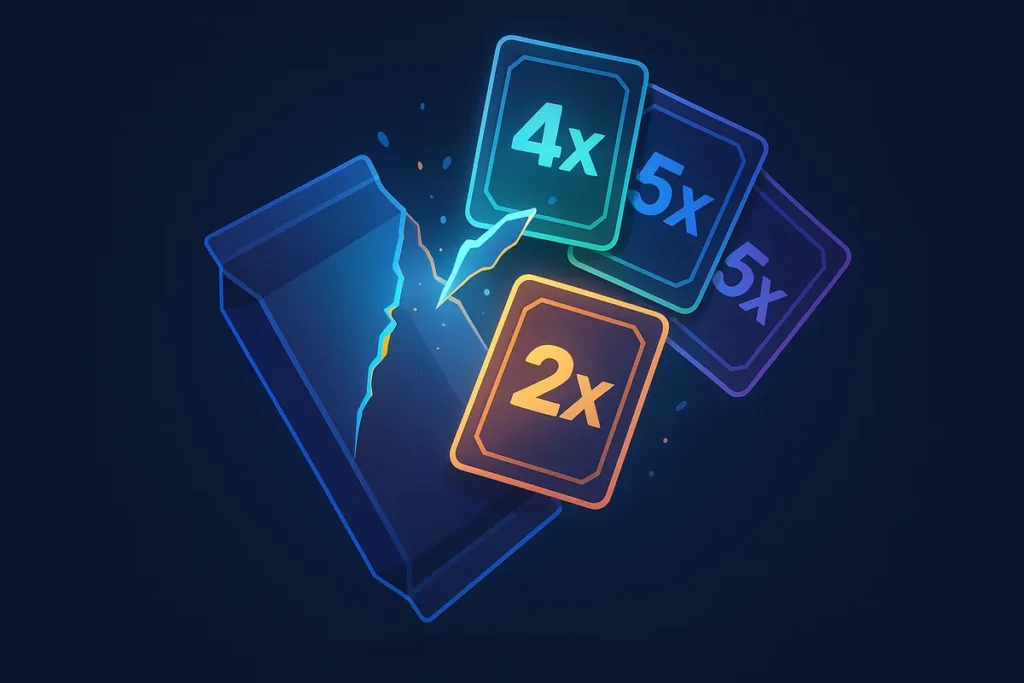
What are virtual pack games?
Let’s kill the obvious myth first: you are not building a card collection worth anything. Virtual pack games borrow the look and the feel of ripping open a booster pack, but the cards vanish when the round ends and nothing accumulates in a shoebox under your bed. What you’re actually buying is a single randomised outcome, priced like a stake.
With that out of the way, here’s the honest definition. Virtual pack games are instant-win casino games in which each round is presented as opening a digital card pack. A random number generator decides what’s inside, the cards are revealed one by one, and the combination of cards and multipliers on them determines whether the round pays and by how much. The mechanic is slot mechanics in a trading card costume: same RNG, same fixed house edge, very different theatre.
The category is small and new. ICONIC21’s Packs, released in September 2026, is the clearest example on the market and the reason anyone is talking about the format at all.
How do virtual pack games work?
The gameplay loop is short and deliberately simple. Here’s what a round looks like in practice:
- You set a stake and “buy” a pack. Your bet is the price of the pack. Some titles offer different pack tiers, which usually means a different bet size and a different prize structure, not better luck.
- The RNG resolves the outcome. This is the part players consistently misunderstand. The result is decided the moment you commit the bet, before a single card appears on screen.
- The reveal sequence plays out. Cards flip one at a time, sometimes with a rarity tier, a suit, or a multiplier printed on them. In ICONIC21’s Packs, the card combinations and attached multipliers are what link to the payout.
- The round pays or it doesn’t, and the cards clear. Then you decide whether to open another.
That third step is doing all the emotional work. A slot’s reels spin and stop in under two seconds. A pack reveal can be stretched over five or six beats, each one a small “is this the good one?” moment. It feels like discovery. Mathematically it’s a single resolved event dressed up as a sequence, exactly like the drum-roll animation on a slot bonus round. If you want the underlying logic, our explainer on how RNGs decide casino outcomes covers why the animation can never change a result that’s already been generated.
One thing worth being clear about: pack games are not loot boxes in the video game sense. In a game like Packs, the reward is a cash payout, and the game is licensed, RTP-declared and regulated like any other casino title. The resemblance is visual, not legal.
ICONIC21’s Packs: the title that defined the format
ICONIC21 launched Packs as a virtual instant game built explicitly around the anticipation of collectible card pack openings. Each round starts with a pack being opened, then a reveal sequence uncovers card combinations and multipliers tied to the potential payout. The studio’s own framing is that it’s translating a mechanic already popular with gaming and collector communities into a fast online casino format.
Two design choices make it representative of where the category is heading:
- Instant-win structure. No reels, no paylines, no free spin trigger to chase. Round starts, round resolves, done. That suits operators who want short sessions sitting alongside their slot lobbies.
- Combination-based payouts. Because the outcome depends on which cards land together and what multipliers ride on them, the paytable can be read like a card hand rather than a symbol grid. It’s more intuitive for players who’ve never bothered learning what a scatter does.
What Packs doesn’t do, and this matters, is hand you a permanent collection. Each round is self-contained. Anyone expecting a binder that fills up over weeks will find the “collectible” part is theme and pacing, not persistent ownership. Before you play, open the game’s information panel and check the declared RTP and the paytable, the same due diligence you’d apply to any slot.
Virtual pack games vs slots: what actually changes
Less than the marketing suggests, and more than nothing. The economics are identical. The experience isn’t.
| Element | Traditional slot | Virtual pack game |
|---|---|---|
| Core action | Spin the reels | Open a pack |
| Outcome engine | RNG, resolved per spin | RNG, resolved per pack |
| Where the tension sits | Reel stop, scatter count, bonus trigger | Card-by-card reveal and rarity tiers |
| Big-win hook | Jackpots, free spins, bonus buys | Rare card and multiplier combinations |
| Round length | 1–3 seconds | Longer, staged reveal |
| Learning curve | Paylines, ways to win, volatility | Read the card combinations |
| What you keep afterwards | Nothing but the balance change | Nothing but the balance change |
| Long-run maths | House edge = 100% − RTP | House edge = 100% − RTP |
The comparison people really want is against non-gambling collectible games, the ones where you keep the cards, trade them, build a deck. On that front the gap is wide. Those games sell you an asset with (arguable) secondary value and a progression curve. A casino pack game sells you a wager with a declared return percentage. Same visual grammar, entirely different product. Confusing the two is how players talk themselves into “investing” in packs, which is a bad way to think about any bet.
Why new casino game categories like this are emerging now
Three forces are pushing hybrid formats forward at once.
Player habits arrived first. A generation of players learned to enjoy pack openings through sports card apps, digital collectibles and card games, plus years of watching other people open packs on streams. The anticipation mechanic needed no explanation. Studios are borrowing a behaviour that already exists rather than teaching a new one.
Slot lobbies are saturated. When an operator has 6,000 slots, a 6,001st Megaways release moves nothing. A game that looks and paces differently earns lobby placement on novelty alone. That’s the commercial logic behind instant-win and crash formats too, and pack games slot into the same gap: simplified mechanics, shorter sessions, something visibly different from reels.
Gamification is the operator obsession. Progression systems, missions and tiered rewards have been bolted onto casino lobbies for years. A game whose native language is rarity and collection fits that layer naturally. If the category grows, expect some studios to attempt genuine cross-round collection meta. Whether regulators are comfortable with persistent collection incentives sitting on top of real-money wagering is an open question, and a fair one. Our coverage of emerging casino game trends tracks how these formats develop.
How to play pack games without fooling yourself
If the format appeals to you, and it’s a genuinely enjoyable presentation, keep three things straight.
First, the pack price is a stake. Reframe “I’ll buy five packs” as “I’ll bet five times” and your decisions get more honest immediately. Second, rarity is a graphic, not an edge. No pack is “due” a rare card, because every round is independent of the last. Third, check the numbers before the theme seduces you: find the declared RTP in the game info, note the volatility, and understand that the difference between 100% and that RTP is the house’s long-run margin. There is no sequence of pack buys that changes it.
Set a deposit or loss limit before you start, keep sessions timed, and if a staged reveal ever starts feeling like a compulsion rather than entertainment, use the cool-off and self-exclusion tools your operator is required to provide. New mechanics deserve curiosity. They don’t deserve a bigger budget than you’d give any other game.
Quick answers
Are virtual pack games rigged because the outcome is decided before the reveal?
No. Pre-determined and rigged are different things. The RNG generates the result at the moment you bet; the animation simply displays it. Licensed games have their RNG and RTP tested by independent labs.
Do virtual pack games have better odds than slots?
Not inherently. Odds depend on the individual game’s RTP and paytable, not the category. Compare the declared RTP of any specific title, as you would with a slot.
Can I keep or trade the cards I open?
In casino pack games like ICONIC21’s Packs, no. The cards exist to determine that round’s payout. Trading and ownership belong to collectible games outside the casino space.