
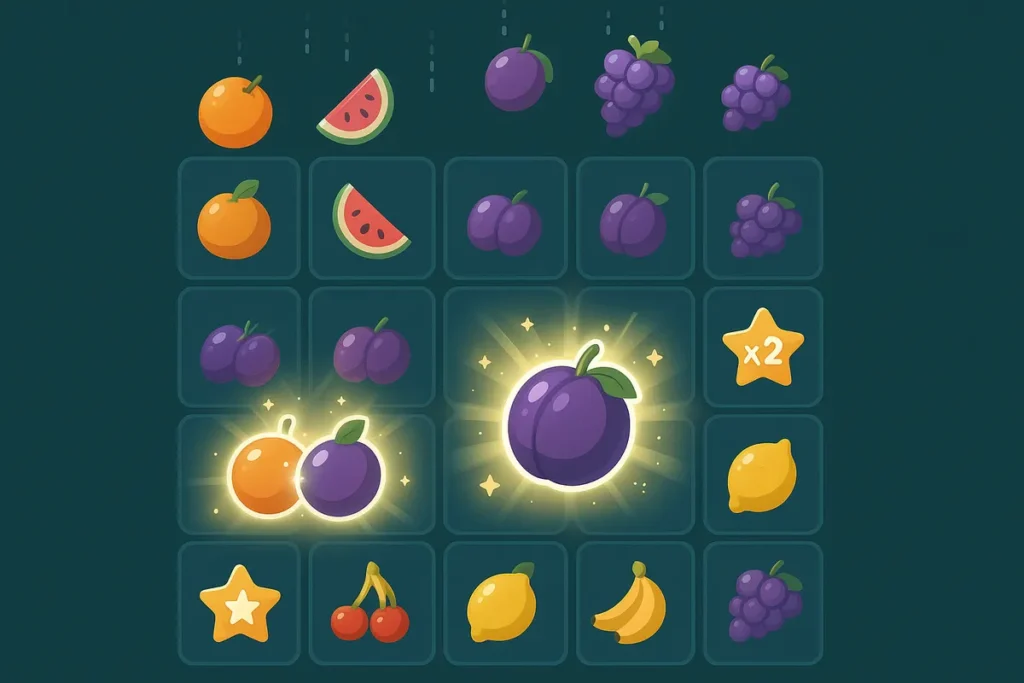
The merge mechanic does not improve your odds. It looks like it should, because you are watching symbols combine into bigger symbols and the grid keeps refilling, but the maths underneath is the same random number generator doing the same job it does on a three-reel fruit machine. What merge changes is the shape of the game: how wins build, how a round feels while it is running, and how the payouts are distributed. Not the house edge.
That distinction matters if you are looking at BGaming’s Bonanza Billion Merge Up+ and trying to work out whether the new feature set is worth your time. So let’s take the mechanic apart.
What is the merge slot mechanic?
The merge slot mechanic is a grid-based feature where identical or related symbols combine into a single higher-value symbol instead of simply paying out and disappearing. Two low-tier fruits merge into one mid-tier fruit; mid-tier symbols merge again into something better. The merged symbol occupies the grid, the spaces left behind get refilled, and the round continues until no further merges or wins are possible.
Three things are happening in sequence:
- Symbol removal. The component symbols are taken off the grid once they combine, the same way winning symbols vanish in a tumble or cascading reels game.
- Symbol upgrade. Instead of the grid just refilling, you are left with a stronger symbol than the ones you started with.
- Chain potential. That upgraded symbol can qualify for the next merge or the next win, so one modest cluster can roll into something much larger without a new spin or a new stake.
None of this is a decision you make. There is no skill element, no timing, no “merge now” button that a sharper player uses better than a casual one. The RNG picks the symbol layout, the merge rules resolve automatically, and the result is already determined before the animation finishes.
How Bonanza Billion Merge Up+ uses merge features
Bonanza Billion Merge Up+ is the latest title in BGaming’s Bonanza Billion series, and the pitch is straightforward: take the fruit-heavy Bonanza Billion presentation players already know and drop in a reworked version of BGaming’s Merge Up feature. The studio describes the “+” version as an upgrade to the original Merge Up mechanic rather than a brand-new idea, built to fix a limitation the first implementation had.
Game grid and layout
Merge mechanics need space to work, which is why they live on grids rather than on narrow three-reel layouts. A merge game needs enough adjacent positions for symbols to find each other, and enough vertical room for the grid to refill after symbols are removed. That is the structural reason you will never see a merge feature bolted onto a classic 5×3 payline slot.
Before you spin, open the game’s info panel and note the exact grid dimensions, the symbol hierarchy (which fruit upgrades into which), the minimum cluster or match size needed to trigger a merge, and the maximum win cap. Those numbers are published in the paytable of every licensed release, and they are the only version of them worth trusting. Anything a third-party site quotes from memory, including this one, is secondhand.
Symbol merge process
The general flow in a merge round looks like this:
- The grid is populated at random when you spin.
- The game checks for qualifying symbol groups under its own merge rule.
- Qualifying symbols are removed and replaced by a single higher-tier symbol.
- Gaps are refilled from above, cascading-reels style.
- The check runs again. If new merges or wins have formed, the sequence repeats.
- When nothing qualifies, the round ends and your balance settles.
The reason merge rounds feel dramatic is step 5. A single spin can resolve in half a second or run through several chained stages, and the long chains are where the big numbers come from. The reason merge rounds are also frustrating is the same step: most of them stop at the first check.
Win calculation method
Merge games pay on symbol values and group sizes, not on lines drawn left to right. Your return for a round is the sum of everything that paid during the chain, multiplied by any multipliers the game applied along the way. That is worth internalising, because it changes how you read the paytable. In a payline slot you ask “what does five of these pay on one line?” In a merge slot you ask “what does the top-tier symbol pay, and how many merges does it take to get there?”
Multipliers, where a game includes them, usually attach to the round rather than to individual wins, so they are applied against the whole accumulated total. Again: the paytable spells out exactly which model the game uses. Read it once, properly, and you will understand the game better than most people playing it.
Merge mechanics vs paylines, cluster pays and Megaways
All four mechanics are RNG-driven and all four have a house edge. What differs is how a win is defined and what happens on screen after it lands.
| Mechanic | How a win forms | What happens after | Practical feel |
|---|---|---|---|
| Traditional paylines | Matching symbols along a fixed line | Round ends, next spin costs a new stake | Fast, predictable, easy to read |
| Cluster pays | A group of adjacent matching symbols, regardless of lines | Winning symbols removed, grid refills (tumble) | Chained wins from one spin |
| Megaways | Left-to-right matches across a variable number of ways to win | Usually cascades, with the ways count rerolling each drop | High variance, wide swing in win potential per spin |
| Merge | Symbols combine into a higher-tier symbol, which can then pay | Upgraded symbol stays on the grid and can merge again | Progressive build-up within a single round |
Merge is closest to cluster pays, and in practice most merge games sit on top of a cluster or tumble engine. The difference is what the removed symbols leave behind. Cluster pays clears them and drops in fresh random symbols. Merge converts them into something stronger, so progress is retained across the chain rather than reset. That is the entire innovation, and it is genuinely a different playing experience even though the underlying probability model is familiar territory.
RTP and volatility in merge slots
RTP is the long-run share of total wagers a game returns, averaged over millions of rounds. Most modern slots typically sit in the 94% to 98% band, with average titles around 94% to 96% and high-RTP releases reaching 97% to 98%. Merge games are spread across that same range, and several sit at the top of it: Merge Up 2 is published at 98% RTP, and Bonanza Billion Merge Up+ at 97.04%. At 96% RTP, ₹100 wagered returns roughly ₹96 on average across that enormous sample, which means the house edge is 4%. Your individual session can land anywhere, and usually lands nowhere near the average.
Two things players routinely get wrong here:
- RTP is not a session forecast. A hundred spins tells you almost nothing about a figure calculated over millions of them.
- Some games ship in multiple RTP versions. Operators can be offered different configurations of the same title, so the number in the info panel at one casino may not match another. Check it where you are playing, not where you read about it.
On volatility, merge mechanics push naturally toward the higher end. When value is concentrated in upgraded top-tier symbols that only appear after a chain of merges, a large share of rounds must end early with little or nothing. That is not a flaw in the design, it is the arithmetic of the design: the same RTP delivered through rarer, bigger outcomes means longer dry stretches in between. High volatility does not change RTP by a single decimal point. It only changes how bumpy the ride to that RTP is.
The practical implication for bankroll is dull but real. A high-variance merge game will eat through a small balance faster at the same stake than a low-volatility payline slot, because it is built to pay less often. If you play these games, size stakes for the number of spins you actually want, set a deposit or loss limit before you start, and treat the money as spent entertainment rather than an investment. Every licensed casino offers deposit limits, session reminders and self-exclusion tools; they take about a minute to switch on.
BGaming’s approach to slot innovation
BGaming is a Malta-headquartered studio with a large slot and crash portfolio, and Bonanza Billion is one of its best-known series. The Merge Up feature is a trademark mechanic the studio has reused across releases, which tells you something about how modern slot development works: a proprietary mechanic gets built once, refined, then re-skinned and iterated across themes and sequels. Bonanza Billion Merge Up+ is exactly that, a familiar theme paired with a second-generation version of an in-house feature.
For players, the useful takeaway is that a studio’s signature mechanic behaves consistently across its games. Learn how Merge Up resolves in one BGaming title and you will read the next one faster. Just don’t confuse familiarity with an edge. Every release still runs on a certified RNG, still publishes an RTP below 100%, and still returns less than it takes over time. That is the deal on every slot ever built, merge mechanic or not.
Frequently asked questions
What is the merge slot mechanic in simple terms?
Identical or related symbols on a grid combine into one higher-value symbol, the gaps refill, and the game checks again for more merges or wins. Wins build up within a single spin instead of resolving instantly.
How does the merge mechanic differ from traditional slots?
Traditional slots pay on fixed lines and end the round immediately. Merge slots pay on symbol groups, remove and upgrade those symbols, and keep resolving until nothing qualifies, so one stake can produce several stages of payouts.
What is Bonanza Billion Merge Up+?
It is BGaming’s latest Bonanza Billion release, pairing the series’ fruit theme with a reworked version of the studio’s Merge Up mechanic, published at 97.04% RTP.
Does the merge mechanic improve my chances of winning?
No. Merge changes how payouts are distributed, not the house edge. The RTP published in the game’s info panel is the figure that matters, and it is always below 100%.
If gambling has stopped being entertainment for you, stop playing and use the self-exclusion tools in your account or contact a support service in your region. Play only if you are of legal age where you live.