
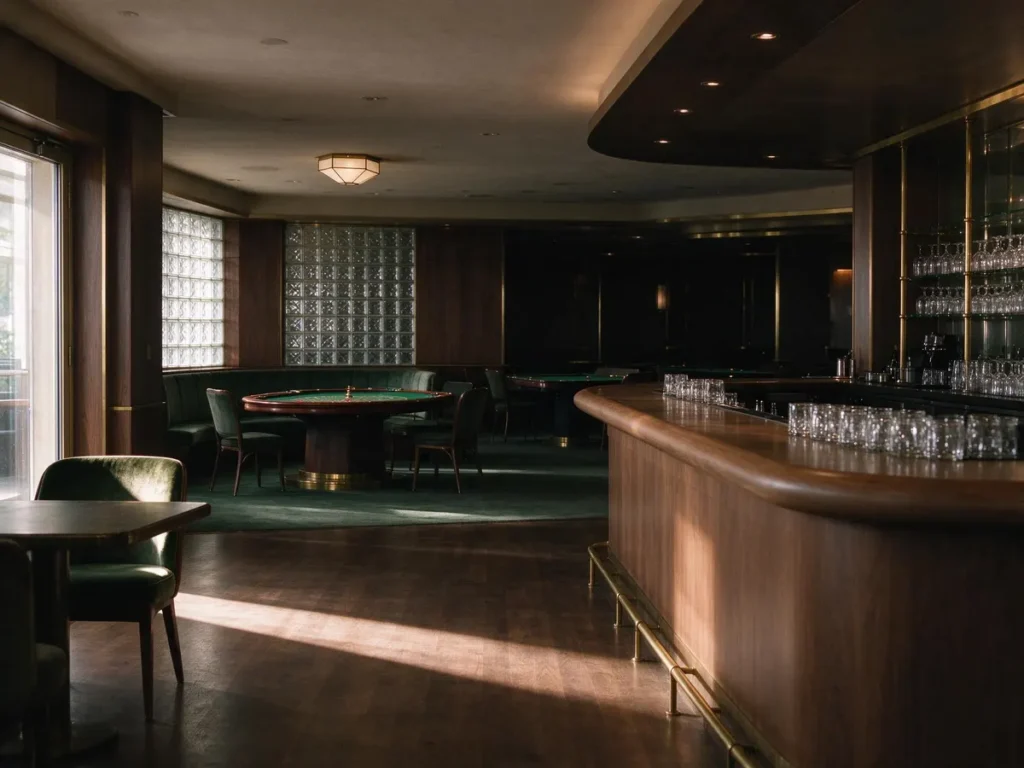
How cinema shaped the way we picture the casino floor
Ask someone to picture a casino and there’s a good chance the image in their head comes from a film rather than an actual trip to Macau or Las Vegas. Decades of movies have built a kind of shorthand for gambling that most audiences accept without much question: tuxedoed dealers, a hush over the baccarat table, one character betting everything on a single hand while a jazz score swells behind him. It makes for compelling cinema. It also, in most cases, bears little resemblance to what gambling actually looks or feels like.
The Bond effect
Start with the obvious reference point. Sean Connery’s Bond films, and later Daniel Craig’s in Casino Royale, made high-stakes card play look almost like diplomacy conducted with chips instead of words. The tables are small, the room is quiet, and the outcome of a single hand can supposedly decide the fate of nations. Real casino floors are louder, faster, and far less exclusive than that. Most tables sit within earshot of slot machines chiming away, and the average hand of poker or blackjack wraps up in seconds, not over some tense three-minute standoff.
That gap between what’s shown and what’s real isn’t necessarily a flaw. Films aren’t documentaries. But it has shaped expectations, and it’s worth just saying that plainly rather than pretending the two line up.
Scorsese, Sorkin, and the mechanics of the house
Where Bond glamorises, films like Casino and Molly’s Game do something more useful: they show the business underneath the game. Casino spends real screen time on surveillance rooms, count rooms, and the quiet arithmetic that keeps a casino profitable no matter who wins any given hand. Molly’s Game, for all its dramatic license, gets one thing right that a lot of gambling movies skip entirely — the house always has an edge over time, and everyone in that world knows it. The tension in these films doesn’t really come from whether luck exists. It comes from what people do when they convince themselves, wrongly, that they can outlast it.
That’s arguably the most honest thread running through serious gambling cinema: the person who thinks they’ve cracked the system is usually the one about to lose the most.
Poker’s odd cinematic status
Poker occupies a strange place in film because it’s one of the few casino games where skill genuinely matters alongside chance. Rounders built its whole premise on this, following a player who reads opponents rather than leaning on fate. It’s a more accurate portrayal of poker specifically than most gambling films manage for casino games generally, since poker is played against other players rather than against a fixed house edge. That distinction rarely survives the jump to screen for other games — roulette, craps, and slots all get the same dramatic treatment even though the math behind them works completely differently.
What the movies leave out
A few things almost never make it into a gambling film, mostly because they’re not dramatic:
- The amount of time spent simply not winning or losing much, which is most of any real session
- Bankroll limits and the decision to walk away before a losing streak escalates
- The fact that comps, free drinks, and loyalty perks exist specifically to keep people playing longer
- How much of the modern gambling experience now happens on a phone screen rather than a physical floor
That last point matters more every year. The industry the movies love to romanticise has largely moved online, and the shift changes the texture of the whole experience considerably. There’s no dealer to read, no room to feel out, no other players’ body language to factor in. What replaces all that atmosphere is convenience and range: a much wider set of games available at once, accessible from a couch instead of a casino floor. Anyone curious about that shift can look at a site like an online casino india platform to see how differently the format presents itself compared to the marble-and-velvet version cinema keeps selling.
Why the myth persists anyway
Even knowing all this, the cinematic version of gambling isn’t going anywhere, and there’s a reason for that. Film runs on stakes and tension, and a game of pure chance dressed up with confident dialogue and a good suit delivers both efficiently. Real gambling, most of the time, is repetitive and unremarkable — which is exactly why it doesn’t make for great drama, and exactly why the movie version keeps getting remade in one form or another.
The useful takeaway isn’t to stop enjoying these films. It’s to hold two things at once: the version on screen is entertainment built for pacing and character, while the actual activity behind it is a form of adult leisure that carries real financial risk and works best treated as a capped, occasional spend rather than a strategy for anything. Anyone drawn to try it for real, whether at a physical table or through a screen, does better going in with that distinction already sorted out than picking it up somewhere in the middle of a losing streak.