
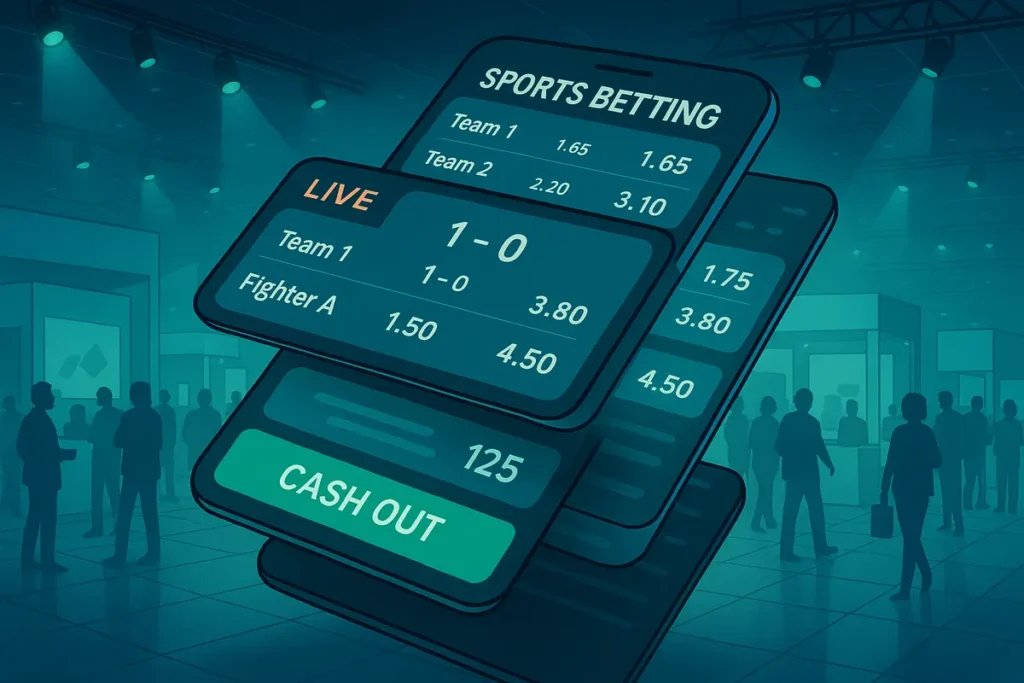
Whose sportsbook are you actually betting on?
When was the last time you opened a betting app and asked who built the thing? Most people never do. You see a brand, a logo, a welcome offer. What you’re really using is a platform licensed from a supplier, configured by an operator, and fed by an odds and data pipeline you’ll never see a line of.
That gap is why a press release about flexible sportsbook solutions matters more to bettors than it sounds. Altenar is heading to SBC Summit 2026 in Lisbon to showcase exactly that: sportsbook technology built to adapt to different regulated markets and support operator growth. The event itself is enormous by industry standards, with organisers expecting around 40,000 industry professionals, 800+ exhibitors and 600+ speakers. Altenar is bringing its sports betting platform and executive commentary on where betting tech is heading.
Nobody at that show is pitching to you. They’re pitching to the operators who decide what your app looks like next year. So it’s worth translating the language, because a fair amount of what bettors believe about odds, markets and live betting is wrong in ways the technology explains.
Myth: “flexible” is vendor waffle that never reaches the player
Reality: flexibility is the exact reason two sportsbooks running the same underlying platform can feel completely different.
A modular sportsbook is a stack of configurable parts: the odds and pricing feed, the market catalogue, the risk and limits engine, the bet builder, live streaming, cash-out rules, bonus mechanics, payments, and the front end that wraps it all. An operator buying a platform doesn’t buy one fixed product. It picks modules, sets parameters, and switches things on by market and by jurisdiction.
So when a supplier says “flexible”, read it as “operator-configurable”. Margin settings, which leagues get deep markets, whether cash-out exists, how aggressively accounts get limited, what happens to your bet when play is suspended. Those are dials, not laws of nature. That’s genuinely useful to know, because it means a feature you hate isn’t necessarily “how betting works” — it’s a choice somebody made in a back office.
Myth: the odds you see were set by the brand you’re betting with
Reality: many brands price off supplied feeds with an operator-set margin on top.
Independent in-house trading teams exist, but plenty of mid-size and regional books run on a platform’s pricing with local adjustments. This is why prices across several apparently unrelated sites cluster so tightly, and why the same obscure Icelandic second-division match shows up on all of them within a minute of each other.
The practical takeaway is unglamorous but real: comparing prices across brands only helps if those brands are actually pricing independently. If three books are running the same feed with similar margin settings, you’re comparing the same number three times. Line differences tend to be wider on lower-tier competitions and niche markets, which is also where margins are fattest — more on that below.
Myth: more markets means better value
Reality: market depth is a product feature, not a generosity feature. Breadth usually comes with a bigger built-in margin.
Every market carries an overround, the bookmaker’s edge baked into the prices. You can measure it yourself in about ten seconds. Convert decimal odds into implied probability (1 ÷ odds), add up both sides of a two-way market, and see how far above 100% the book sits. Anything over 100% is the margin.
| Two-way market prices | Implied probability (each side) | Total book | Overround |
|---|---|---|---|
| 2.00 / 2.00 | 50.00% | 100.00% | 0% (theoretical only) |
| 1.95 / 1.95 | 51.28% | 102.56% | 2.56% |
| 1.90 / 1.90 | 52.63% | 105.26% | 5.26% |
| 1.83 / 1.83 | 54.64% | 109.29% | 9.29% |
Headline markets on big events are competitive and thin on margin. Deep niche markets, player props on minor leagues, and multi-leg bet builders are where the edge widens, because pricing correlated legs is harder and the supplier prices in that uncertainty. A flexible platform makes it trivially easy for an operator to flood the app with thousands of extra markets. That expansion is good for engagement metrics. It is not automatically good for your expected return, and it’s worth doing the arithmetic on anything exotic before you back it.
Myth: in-play betting happens in real time
Reality: you are betting on a delayed picture, and the platform knows it.
Live betting runs on data feeds from the venue, prices recalculated continuously, and a stream that reaches your phone seconds behind the actual event. Every in-play sportsbook therefore builds in protections: a bet acceptance delay of a few seconds, automatic suspension when a goal or a point is scored, and price re-offers when the line moves while your slip is open.
None of that is a glitch. It’s the risk module doing its job, and it’s why “I saw it happen before the odds changed” almost never turns into a winning bet. If your stream and the market are both behind the truth, you’re not ahead of the book. Treat the delay as a fixed feature of live betting rather than an exploitable gap.
Myth: cash-out is a neutral escape hatch
Reality: cash-out is a priced product, and the price includes a margin.
A cash-out figure is the platform recalculating your bet at current odds and then taking a cut for the convenience of settling early. Over many uses, cashing out routinely costs you value compared with letting bets run. It can still be the right call if you want certainty or you’ve simply had enough of a bad afternoon, and the emotional case for it is legitimate. Just don’t mistake it for a maths advantage.
Same logic applies to bonuses running on the same stack. A free bet or an odds boost is a configurable promo module with terms attached: minimum odds, market restrictions, turnover requirements, maximum payouts. Read the conditions, because that’s where the offer’s actual value is decided.
Myth: a flexible platform will be flexible with you
Reality: the flexibility points at the operator, not the customer.
The same modularity that lets a book launch fast in a new regulated market also lets it tighten stake limits on a specific account, cap liability on a market, or restrict bet types for certain users. Risk management is a core part of any serious betting platform technology, and suppliers sell it as a selling point because it protects operator margin.
There’s an upside to this that gets undersold: responsible gambling tooling lives in the same configurable layer. Deposit limits, loss limits, session reminders, cool-off periods and self-exclusion are standard platform features in regulated markets. If your sportsbook buries them, that’s a design decision, not a technical limitation. Use them, and set them before you’re in a hole rather than after.
What to actually take from Lisbon
Trade shows like SBC Summit Lisbon 2026 are where next season’s app features get sold. Suppliers such as Altenar demo the sportsbook platform features, operators shop, and roughly a year later the results appear on your screen as new bet builders, more live markets, faster settlement, slicker promo mechanics.
Three habits make you a sharper customer of all that:
- Calculate the overround on any market you bet regularly. If the book sits well above 105%, you’re paying for the convenience of that market existing.
- Check whether the books you compare actually price independently. Identical odds across brands usually means a shared feed, not a fair price.
- Read the promo terms and set your own limits inside the app on day one, not month six.
The house edge is structural in every sportsbook, however modern the platform behind it. Understanding the technology won’t remove that edge, but it does stop you misreading a product decision as a betting opportunity. Bet only what you can comfortably lose, and if it stops being entertainment, use the limit and self-exclusion tools that every regulated operator is obliged to give you.