
A cricket betting price is a bookmaker’s estimate of probability, written as a payout. That’s the one-line version, and it’s slightly wrong in a way that matters: the price you see is a probability estimate plus a built-in profit margin for the bookmaker. Learn to separate those two things and cricket betting odds stop looking like tips and start looking like what they are, which is arithmetic with a fee attached.
This guide walks through that arithmetic step by step: how to read a price, convert between formats, turn it into a percentage, and work out how much of the market the house has taken before a ball is bowled. It’s an explainer, not encouragement. Every market described here carries a negative expected return over time, and that’s not an opinion, it’s the maths.
How cricket betting odds work: the basics
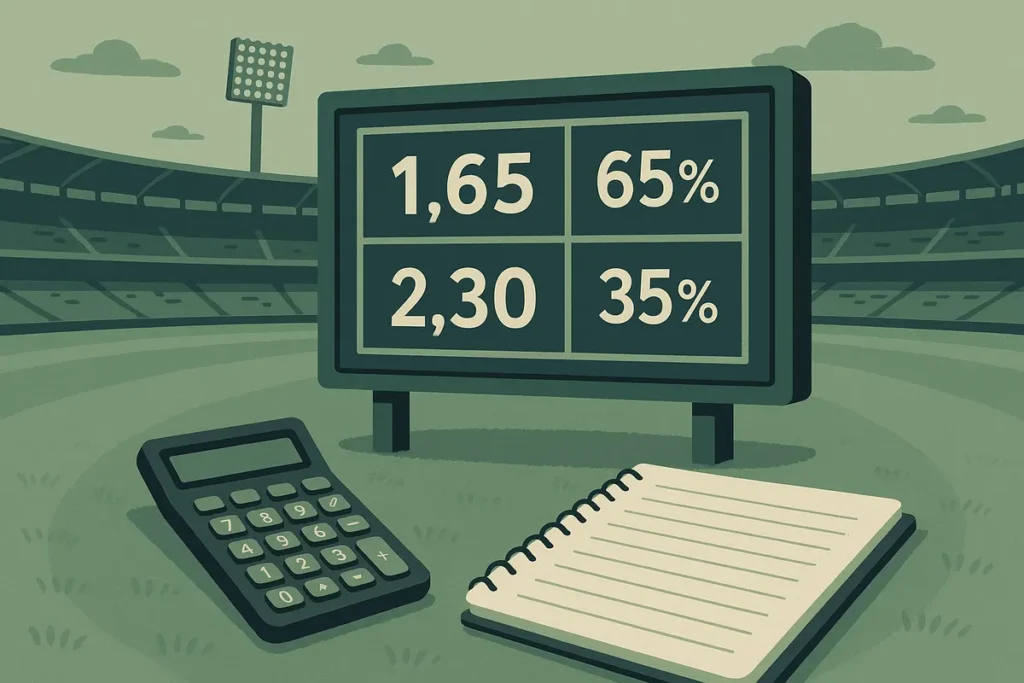
Odds do two jobs at once. They tell you what a winning bet returns, and they tell you what probability the bookmaker has priced in. If India are 1.65 to beat Australia, a successful ₹1,000 bet returns ₹1,650 in total (₹650 profit), and the implied chance of that result is roughly 60%.
Three things the odds are not:
- A prediction. Bookmakers price to balance liability and take a margin, not to forecast. Prices move because money moves, team news lands, or a pitch report changes expectations.
- A fair reflection of probability. Every market is shaded so the sum of implied chances exceeds 100%. More on that below.
- A guarantee of anything. A 1.20 favourite loses often enough to hurt. T20 cricket in particular is volatile; one over can rewrite a match.
Odds also shift constantly during live play, which is why the number you screenshot at the toss is a snapshot, not a fixed value.
Decimal vs fractional odds: reading the numbers
Two formats dominate cricket. Most sites serving Indian users default to decimal odds; UK media and older bookmakers often quote fractional odds. They express the same thing.
Decimal odds show total return per unit staked, stake included. At 2.50, ₹1,000 returns ₹2,500 (₹1,500 profit).
Fractional odds show profit relative to stake. At 3/2, a ₹200 stake wins ₹300 profit and returns ₹500.
The conversions are one-liners:
- Fractional → decimal: divide the fraction, then add 1. So 3/2 = 1.5, + 1 = 2.50.
- Decimal → fractional: subtract 1, then express as a fraction. So 2.50 − 1 = 1.5 = 3/2.
Here’s the same ladder of prices in both formats, with implied probability and the return on a ₹1,000 stake.
| Fractional | Decimal | Implied probability | Total return on ₹1,000 |
|---|---|---|---|
| 1/4 | 1.25 | 80.0% | ₹1,250 |
| 1/2 | 1.50 | 66.7% | ₹1,500 |
| 4/5 | 1.80 | 55.6% | ₹1,800 |
| 1/1 (evens) | 2.00 | 50.0% | ₹2,000 |
| 3/2 | 2.50 | 40.0% | ₹2,500 |
| 2/1 | 3.00 | 33.3% | ₹3,000 |
| 4/1 | 5.00 | 20.0% | ₹5,000 |
| 9/1 | 10.00 | 10.0% | ₹10,000 |
Decimal is easier for mental maths, which is why it wins for most people. Multiply stake by price and you have the return, no separate step for getting your stake back.
Implied probability: what the odds really mean
To convert any decimal price into a percentage, divide 1 by the price and multiply by 100.
Take an illustrative India vs Australia match market: India 1.65, Australia 2.30 (no draw in a completed limited-overs game).
- India: 1 ÷ 1.65 = 0.6061 → 60.61%
- Australia: 1 ÷ 2.30 = 0.4348 → 43.48%
Add them: 104.08%. That extra 4.08 percentage points is not a rounding error. Probabilities for all possible outcomes of a single event have to sum to 100%, so the market is telling you it has been deliberately inflated. Everything above 100% is the bookmaker’s cut.
You can strip it out to see the implied “fair” view. Divide each probability by the total: 60.61 ÷ 104.08 = 58.23% for India, 43.48 ÷ 104.08 = 41.77% for Australia. Convert those back to prices (1 ÷ probability) and you get about 1.72 and 2.39 — a margin-free version of the same market. The gap between 1.65 and 1.72 is what you’re paying to place the bet.
Bookmaker margin: why the house always wins over time
The sum of implied probabilities is called the overround. The bookmaker margin (also called the vig or juice) is the share of every rupee staked that the operator expects to keep, and you get it with:
margin = 1 − (1 ÷ overround as a decimal)
For our match market: 1 − (1 ÷ 1.0408) = 0.0392, so roughly 3.9%. That’s the house edge on that market, the same concept as the house edge on a casino game, just expressed through prices instead of a paytable.
Margins vary by market, and the pattern is consistent: the more outcomes and the more obscure the market, the wider the cut.
| Market (illustrative prices) | Sum of implied probability | Approx. margin |
|---|---|---|
| Match winner: 1.65 / 2.30 | 104.1% | 3.9% |
| Over/under 175.5 runs: 1.90 / 1.95 | 103.9% | 3.8% |
| Toss winner: 1.90 / 1.90 | 105.3% | 5.0% |
| Top batsman (8+ runners) | Often 110%+ | 10% or more |
Toss betting is the cleanest illustration. A coin toss is as close to a genuine 50/50 as cricket offers, so the fair price is 2.00 on each side. Offer 1.90 both ways and the operator keeps about 5% of turnover regardless of which way the coin lands. No skill, no information, no edge available to you. That’s why experienced bettors treat the toss as a pure fee.
Cricket betting markets explained
Once you can read prices and margins, the markets themselves are straightforward. These four cover most of what you’ll see on an IPL or international fixture.
Match winner odds
The simplest market: which team wins. In limited-overs cricket there are usually two outcomes, so margins tend to be tightest here. Test matches add a draw, giving three prices and a slightly wider overround. Watch for “tied match” and “no result” rules in the terms, since abandoned games are normally voided and stakes returned, but the exact wording differs by operator.
Toss betting
Heads or tails, essentially. Priced around 1.90 to 1.95 on both sides, which as shown above bakes in a 3% to 5% margin on a genuinely even proposition. Some sites also offer “toss winner and match winner” combinations, which multiply two margins together, making the combined cut larger than either market alone.
Player performance markets
Top batsman, top bowler, player runs over/under, most sixes and similar. These carry the widest margins in cricket because each market has many possible winners and the bookmaker adds a shade to each one. A top batsman market with eight or ten named players can easily total 110% to 120% of implied probability. They’re also the most exposed to chance: an opener at a short price can be dismissed in the first over and the market is settled against you before the powerplay ends.
Over/under runs
You bet on whether a total (team innings runs, match runs, runs in the first six overs) finishes above or below a set line, usually with a half-run to avoid ties, for example over 175.5. Prices sit close to even money on both sides, and the line moves with pitch conditions, dew forecasts and team sheets. A line of 175.5 at 1.90 / 1.95 implies 52.63% and 51.28% respectively, adding to 103.9% and a margin near 3.8%.
Reading IPL and T20 odds
T20 compresses everything. Twenty overs a side means a single big over, a rain interruption or one collapse swings the result far more than it would in a 50-over or five-day game, and the prices reflect that:
- Narrower match-winner ranges. Even a clear mismatch in the IPL often sits somewhere around 1.50 to 2.60 rather than the 1.10 shorties you see in other sports, because upsets are common.
- Sharper in-play swings. Live odds on T20 can flip from odds-on to odds-against within an over. That volatility is real, not a pricing glitch.
- Higher variance in player markets. Batting order changes, impact substitutions and short innings make individual player outcomes very noisy, which is part of why margins on those markets are wider.
- Venue effects on run lines. Over/under totals differ substantially between a small, high-scoring ground and a slower surface, so compare the line, not just the price.
One practical habit: before you evaluate any IPL price, convert it to a percentage and add up the market. If the overround is 104%, you’re paying about 4%. If it’s 112%, you’re paying about 11% for the privilege of a more exciting bet. The number tells you more about the market than any preview will.
Quick answers
How do cricket betting odds work?
They express an implied probability as a payout. Decimal odds show total return per unit staked (2.50 returns 2.5× your stake), and the implied chance is 1 ÷ the price. Bookmakers shade those prices so the market totals more than 100%, and that excess is their margin.
What is implied probability in betting odds?
The chance of an outcome that the price reflects. Calculate it with 1 ÷ decimal odds × 100. A price of 1.65 implies 60.61%; a price of 4.00 implies 25%.
What is the bookmaker’s margin?
The built-in edge, found by adding the implied probabilities of every outcome and subtracting 100%. A market summing to 105% has roughly a 5% margin, meaning the operator expects to keep about ₹5 of every ₹100 staked across that market over time.
What are the main cricket betting markets?
Match winner, toss winner, player performance markets such as top batsman and top bowler, and over/under run totals. Match winner usually carries the smallest margin; player markets usually the largest.
Before you use any of this
Understanding odds makes you a better reader of markets. It does not make betting profitable, and nothing above is a system. The margin is charged on every bet you place, which means the longer you bet, the more certainly the house edge shows up in your balance.
Betting is for adults aged 18 and over, and rules on online betting differ across Indian states, with some prohibiting it outright, so check what applies where you live. If you do bet, set deposit and loss limits before you start, treat the money as spent entertainment rather than income, and use cool-off or self-exclusion tools if it stops feeling like a game. Our responsible gambling guide covers those tools in more detail, and our other betting explainers break down individual markets further.