
Here is the myth that costs affiliate teams the most money: “if something changes in the platform, we’ll know who did it.” You usually won’t. Without proper affiliate platform audit logs, all you have is a current state, a Slack thread, and two people who remember the meeting differently. That is not a record. It is a disagreement waiting for an invoice.
The gap matters more now that platforms are treating change tracking as standard plumbing rather than an enterprise add-on. ReferOn’s rollout of native audit logs is a useful marker of where the sector is heading, and a good excuse to take apart the assumptions that keep affiliate programmes exposed.
What affiliate platform audit logs actually are
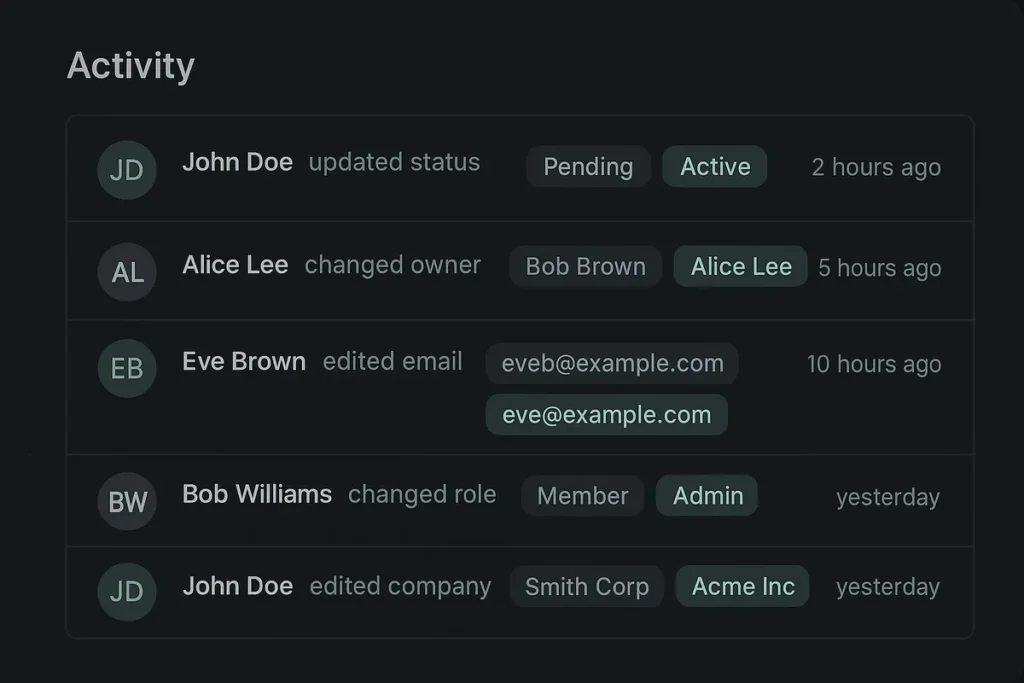
An audit log is a chronological, read-only record of every administrative action taken inside your platform: who did it, what they changed, when, and what the value was before and after. In an affiliate context that covers commission plans, partner account statuses, permission grants, payout approvals, tracking link settings, postback configuration and system-level toggles.
The distinction people miss is between a log and a history. A “history” tab usually shows you the last few edits to one record. A proper audit trail is platform-wide, searchable, attributed to a named user or API key, and immutable, meaning nobody, including your own admins, can quietly rewrite it. That immutability is the whole point. A log you can edit is just another document.
Myth: database backups cover this. Reality: backups tell you what the data looked like on Tuesday. They do not tell you that Marcus dropped a partner’s revenue share from 35% to 25% on Wednesday afternoon, three days before the affiliate noticed their earnings fell off a cliff. Reconstructing intent from snapshots is forensic work. Reading a log takes thirty seconds.
ReferOn’s native audit logs and what the rollout signals
ReferOn launched native audit logs as a standard, platform-wide feature for both existing and new clients, building a centralised, traceable ledger of system activity. Actions taken across the platform are gathered into a single searchable dashboard, with the stated aim of streamlining compliance work and resolving partner disputes.
Two details are worth pulling out, because they say more about the industry than about any one vendor.
First, it shipped as standard rather than as a premium tier. When a governance feature stops being an upsell, it has crossed from “nice differentiator” into “expected baseline.” Operators running multiple brands increasingly ask about change tracking during procurement, not after an incident.
Second, the framing is centralisation. Most affiliate operations already produce log data somewhere, scattered across CRM notes, email approvals, finance spreadsheets and server logs that only engineering can read. Scattered evidence is nearly worthless when a regulator gives you ten working days to explain a commission change. One queryable ledger is what turns raw data into an actual audit trail.
Myth: this is a compliance-department feature. Reality: the first people to use it are affiliate managers settling arguments, and the second are finance teams reconciling payouts.
The admin changes that cause real disputes
Not every click needs a permanent record, but a specific set of actions reliably turns into money or licence risk. If your admin change tracking covers nothing else, cover these.
Commission structure modifications
Commission edits are the number one source of partner conflict, and they are easy to make quietly. A revenue share percentage, a CPA value, a hybrid deal’s threshold, negative carryover settings, admin fee deductions, a brand or country excluded from a deal: each one changes what a partner earns, sometimes retroactively.
Log the before value, the after value, the effective date, and whether the change applied retrospectively. That last field settles more disputes than anything else. “We agreed on the new rate for October” versus “it was backdated to July” is a five-figure conversation.
User access and permission changes
Every permission grant expands the set of people who can move money. You want a record each time an admin account is created, a role is elevated, an API key is issued or rotated, a two-factor requirement is disabled, or a departing employee’s access is (or is not) revoked.
Access logs also matter under data protection rules, because affiliate platforms hold personal data on partners and, depending on integration, player-level identifiers. Being able to show who viewed or exported that data is a standard expectation, not a bonus.
Payment and payout adjustments
Manual adjustments are where fraud hides, precisely because they are legitimate most of the time. Corrections, bonuses, clawbacks, negative balance resets, payment method edits, minimum payout threshold changes, currency switches, blocked or approved withdrawals: all of it needs a name and a timestamp attached.
A useful rule: if an action changes a number a partner gets paid on, or changes where that money goes, it is logged with a mandatory reason field. The reason field is annoying to fill in and invaluable six months later.
Here is a practical minimum for the highest-risk areas:
| Change type | Capture at minimum | Why it matters |
|---|---|---|
| Commission plan edit | Old and new values, effective date, retroactive flag, actor | Primary source of partner payment disputes |
| Partner account status | Previous status, new status, reason, actor | Explains suspended traffic and withheld earnings |
| Admin role or permission | Role before and after, granting user, timestamp | Shows who could authorise financial actions, and when |
| Manual balance adjustment | Amount, direction, reason code, approver | Detects error patterns and internal fraud |
| Payment details update | Field changed, requester, verification step taken | Core control against payout redirection fraud |
| Tracking or postback config | Prior configuration, new configuration, actor | Explains attribution gaps and missing conversions |
Why affiliate platform transparency earns you better partners
Myth: exposing your internal changes hands affiliates ammunition. Reality: it removes their main reason to distrust you.
Think about how affiliate disputes actually play out. A partner’s revenue dips. They suspect their deal was altered, their conversions were scrubbed, or their traffic was reclassified. You say nothing changed. They cannot verify that, so they hedge by shifting traffic to an operator they trust more. You lose volume over a misunderstanding you could have cleared up with a timestamp.
An audit trail collapses that cycle. You can state plainly that the commission plan has not been touched since a specific date, that a status change was made by a named compliance reviewer for a stated reason, or that the postback endpoint was updated at 14:12 and yes, that explains the missing four hours of conversions. Sometimes the log proves you made a mistake. Paying for a mistake you found yourself costs far less than one a partner discovers publicly.
On the regulatory side, the value is similar but the audience is stricter. Licensed markets expect operators to demonstrate administrative oversight: documented controls, segregation of duties, evidence that marketing terms and affiliate conduct decisions were authorised by the right people. When a regulator asks how a non-compliant promotion got approved, “we believe it was signed off internally” is not an answer. A log entry is. Retention periods vary by licence, so check what your own conditions require rather than assuming a default.
Building an audit trail in iGaming that holds up under scrutiny
Myth: switching the feature on is the project. Reality: switching it on is week one. Making it usable and trustworthy is the work.
- Log the actor, not the account. Shared logins destroy accountability. If three managers use one admin account, your log tells you a change happened but not who owns it. Individual accounts with named roles come first.
- Record before and after values. “Commission plan updated” is a notification. “Revenue share changed from 30% to 22%, effective 1 March” is evidence.
- Make entries append-only. Nobody, at any privilege level, should be able to delete or edit a log line. If your platform allows it, that is a finding waiting to be written up.
- Include API and automated actions. Integrations and scripts change data too. Logs that only cover the UI miss a growing share of activity.
- Standardise reason codes. Free-text notes rot. A short fixed list for adjustments and status changes makes the log queryable and turns it into a source of pattern analysis.
- Give non-technical staff access. If only engineering can run a query, affiliate managers will keep relying on memory. Filters by user, date range, partner ID and action type are the difference between a compliance asset and a dormant table.
- Review proactively. Set a monthly check on high-risk categories: manual adjustments, permission escalations, payment detail edits. Logs are a detective control, and detective controls only work if somebody looks.
- Define retention and export before you need them. Know how long entries are kept, in what format they export, and who can produce them under deadline. Discovering the answer during an audit is the expensive way.
One caveat worth holding onto: an audit log records what happened, not whether it was right. It will not stop a bad commission decision or an unauthorised approval. What it does is make both visible, quickly, to the people who can fix them. That is a modest promise, and it is exactly why change tracking has moved from a checkbox in a procurement document to something you should expect your platform to do by default.
Frequently asked questions
What are audit logs in affiliate platforms?
They are immutable, timestamped records of administrative actions inside the platform, showing which user changed what, when, and from which value to which value. Typical coverage includes commission plans, partner statuses, permissions, payout adjustments and tracking configuration.
Why do affiliate platforms need audit logs?
Three reasons: settling partner payment disputes with evidence rather than recollection, satisfying licence and data protection expectations around administrative oversight, and detecting internal errors or fraud in manual financial adjustments before they compound.
How do audit logs improve transparency?
They let you answer a partner’s question with a verifiable record instead of an assurance. When an operator can show exactly when a deal changed and who authorised it, affiliates have far less reason to assume silent adjustments and far more reason to keep sending traffic.
Do small affiliate programmes need this?
Yes, and arguably more than large ones. Small teams run on trust and shared accounts, which is precisely the setup where one undocumented change becomes an unwinnable argument. Individual admin logins plus a basic change log cost nothing and prevent most of the damage.